Polylaminin: A Biomimetic ECM Scaffold for Neural Repair

Introduction
The adult central nervous system (CNS) has a limited capacity for self-repair. Following spinal cord injury (SCI), the initial mechanical trauma is followed by secondary damage that includes inflammation, neuronal loss, glial scar formation, and disruption of the extracellular matrix (ECM). These processes collectively create an environment that restricts axonal regeneration.
The ECM of the nervous system is not only structural but also a key regulator of cell behavior. It influences neuronal survival, migration, differentiation, and axon extension. Because of this, the organization of the ECM plays a major role in determining whether regeneration can occur.
Laminin: A Central Component of Neural ECM
Laminin is a heterotrimeric glycoprotein found in basement membranes and specialized ECM structures. It supports:
- neuronal survival
- cell migration
- axon growth
- neuronal differentiation
- myelination
Genetic studies have shown that laminin deficiency leads to profound developmental abnormalities, including impaired axon guidance, disrupted cortical organization, and instability of the blood–brain barrier.
Why Soluble Laminin Alone Falls Short
Although laminin is essential for neural repair, therapeutic delivery of soluble laminin has had limited impact in SCI models. This limitation is largely structural. In native tissue, laminin does not act as isolated molecules. It assembles into organized polymeric networks, and this architecture is crucial for effective receptor signaling (such as integrin-mediated pathways).
Non-polymerized laminin lacks this supramolecular organization, resulting in significantly reduced biological activity.
What Is Polylaminin?
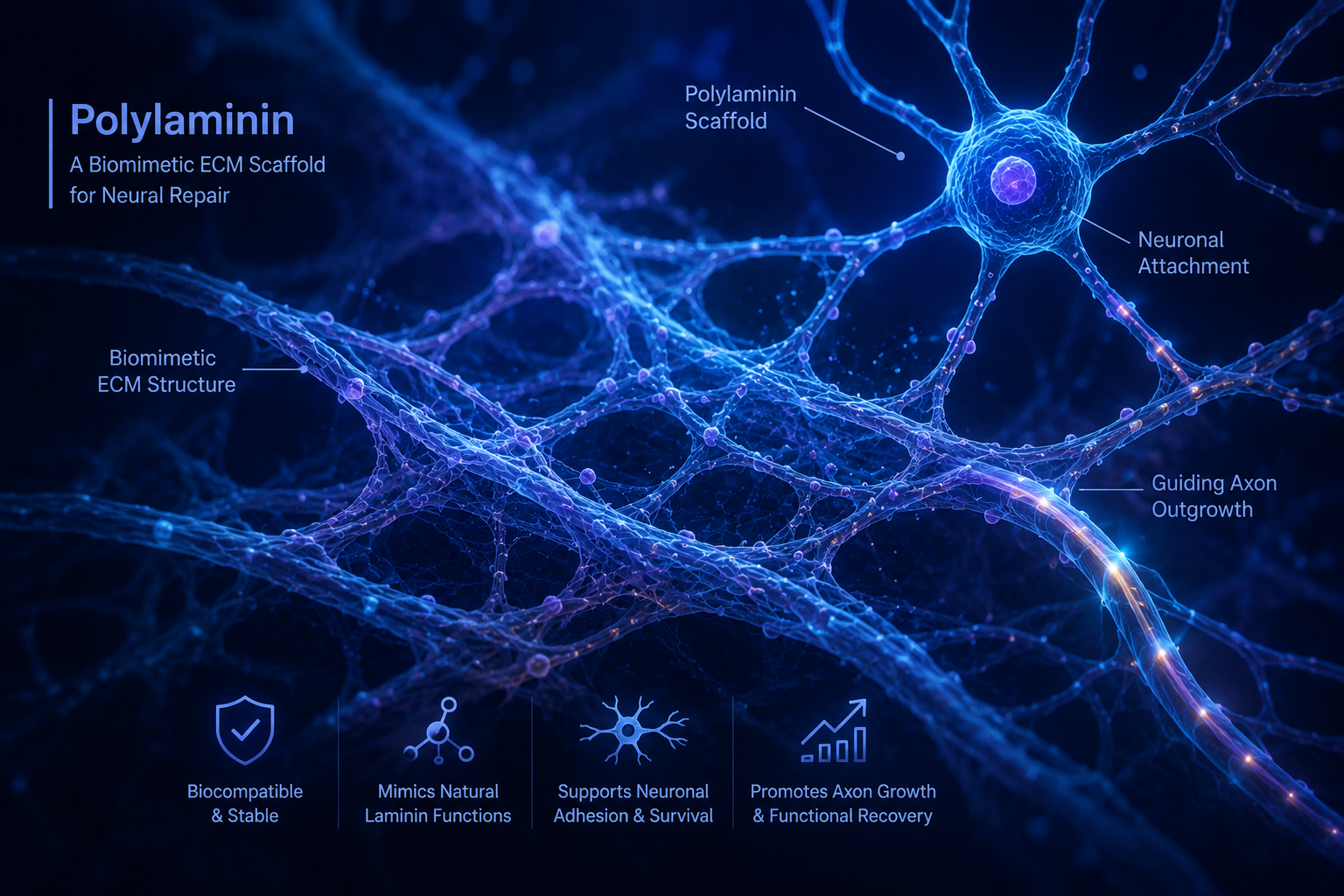
Polylaminin is a polymerized, stabilized form of laminin created under specific conditions (such as low pH) that promote molecular self-assembly.
Its defining features include:
- a hexagonal network architecture
- close structural resemblance to native basement membrane laminin
- a biomimetic organization that more accurately reflects physiological ECM structure
In this way, polylaminin recreates the natural supramolecular environment that supports neuronal growth.
Functional Differences: Polylaminin vs. Conventional Laminin
In vitro studies demonstrate that ECM organization strongly affects neuronal behavior. Compared with non-polymerized laminin, polylaminin has been shown to promote:
- increased neurite outgrowth
- greater neurite length
- enhanced neuronal differentiation
At the signaling level, ECM architecture influences downstream pathways:
- Polylaminin predominantly activates the PKA pathway, which is associated with neurite extension.
- Non-polymerized laminin tends to activate PKC and MLCK, pathways less supportive of robust neurite growth.
These findings indicate that ECM structure is not merely supportive — it determines the cellular signaling outcomes that guide regeneration.
Evidence from Animal Models of SCI
Several animal models (including contusion, hemisection, and complete transection) have evaluated the effects of a single intralesional dose of polylaminin delivered during the acute injury phase.
Functional Outcomes
Using the BBB locomotor scale:
- control animals typically score around 4 after eight weeks
- polylaminin-treated animals score 8–9
This improvement represents a meaningful enhancement in locomotor performance.
Histological Findings
Studies report:
- reduced lesion cavity size
- greater preservation of white and gray matter
- reduced glial scar formation
- improved overall tissue organization
Modulation of Inflammation
Polylaminin appears to influence early inflammatory responses:
- reduced macrophage and microglial infiltration
- better containment of inflammation near the lesion border
- lower systemic markers such as CRP
These effects point toward early neuroprotective properties.
Axonal Guidance
A notable observation is that regenerating axons often extend along laminin-rich, channel-like structures, suggesting that polylaminin provides not only structural support but also guidance cues for axonal growth.
Limitations of Human Data
While preliminary human observations are encouraging, several important limitations remain:
- small sample sizes
- lack of control groups
- open-label designs
- limited peer-reviewed publication
Because of this, current findings should be regarded as preliminary rather than conclusive.
Closing Note
Polylaminin represents a biologically informed approach to rebuilding ECM architecture after SCI. By restoring a structure more closely aligned with native laminin networks, it provides both protective and growth-supportive cues. Although early data are promising, further controlled research is needed to clarify its therapeutic potential in humans.