Thymosin β4 (TB-500): A Multifunctional Peptide in Neural and Tissue Repair


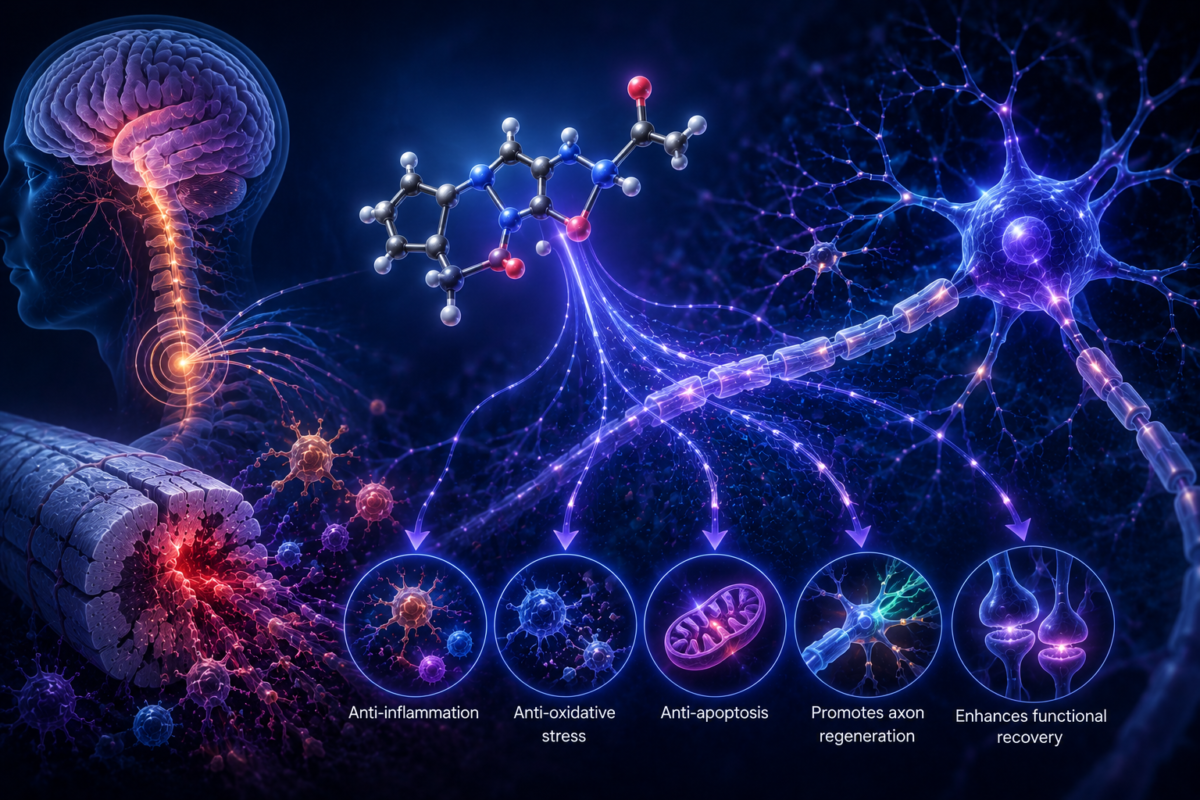
Thymosin β4 (Tβ4), also known in synthetic research form as TB-500, is a naturally occurring 43–amino acid peptide found widely in human tissues. It plays key roles in wound repair, immune regulation, angiogenesis, and cytoskeletal dynamics. Because spinal cord injury (SCI) involves inflammation, microvascular disruption, demyelination, and loss of structural integrity, Tβ4 has become an important molecule in preclinical research on neural repair.
Why Tβ4/TB-500 Is of Interest in CNS Recovery
Tβ4 regulates actin, the central protein required for cell migration, axon extension, and tissue remodeling. It also influences:
- angiogenesis and vascular stability
- inflammatory signaling pathways
- oligodendrocyte progenitor cell recruitment
- remyelination
- structural reorganization of surviving tissue
These functions make it relevant not only for SCI but also for stroke, traumatic brain injury, multiple sclerosis, and peripheral nerve injury.
Findings in Spinal Cord Injury (SCI)
In a thoracic contusion SCI model, systemic Tβ4 treatment produced several consistent biological effects:
- More surviving neurons near the injury site
- Greater preservation of oligodendrocytes and myelin
- Reduced expression of pro-inflammatory cytokines (TNF-α, IL-1β, IL-6, MCP-1, MIP-2)
- Increased IL-10, a regulatory cytokine
- Smaller lesion cavities and better tissue architecture
- Improved locomotor performance measured by BBB scoring and gait analysis
These findings suggest both reduced secondary damage and enhanced endogenous repair processes.
Evidence from Other Neurological Models
Stroke
Tβ4 increased oligodendrocyte progenitors, mature oligodendrocytes, and white-matter integrity, with functional recovery even when treatment began 24 hours after injury.
Multiple Sclerosis (EAE)
Studies report reduced clinical severity, enhanced remyelination, and moderated inflammatory responses.
Traumatic Brain Injury
Tβ4 improved motor and cognitive outcomes and increased mature oligodendrocytes in white-matter pathways.
Across models, Tβ4 appears to act primarily as a neurorestorative agent—stimulating repair in surviving neural circuits—rather than solely protecting cells at the moment of injury.
Safety Background
A Phase 1 clinical trial in healthy adults found Tβ4 to be well tolerated, with no serious adverse events and predictable pharmacokinetics.
Although TB-500 is a synthetic research analogue rather than a pharmaceutical preparation, the safety data for full-length Tβ4 supports continued exploration of this biology in controlled research settings.
Summary
Thymosin β4 (TB-500) influences multiple pathways relevant to SCI and neurological injury, including inflammation control, vascular protection, cytoskeletal remodeling, remyelination, and axonal sprouting. While it has not yet been clinically tested for SCI, the consistency of findings across animal models highlights its potential value for future neuroregenerative strategies.
References
Spinal Cord Injury Studies
- Cheng, P. et al. Beneficial effects of thymosin β4 on spinal cord injury in the rat. Neuropharmacology. 2014.
- Zuo, J. et al. Thymosin β4 promotes axonal regeneration after spinal cord injury. Neuroscience. 2021.
Traumatic Brain Injury (TBI)
3. Xiong, Y. et al. Thymosin β4 improves functional outcome after traumatic brain injury. Journal of Neuroscience Research. 2012.
4. Morris, D. et al. Thymosin β4 promotes oligodendrogenesis and white matter repair after TBI. Journal of Neuroscience. 2014.
Stroke
5. Zhang, Z.G. et al. Thymosin β4 promotes axonal plasticity and functional recovery after stroke. PNAS. 2009.
6. Chopp, M., & Zhang, Z.G. Thymosin β4 in stroke recovery and neurorestoration. Annals of the New York Academy of Sciences. 2012.
Multiple Sclerosis (EAE)
7. Napoli, I. et al. Thymosin β4 regulates oligodendrocyte progenitor cell differentiation and promotes remyelination. Glia. 2012.
8. Cavasin, M.A. et al. Thymosin β4 reduces inflammation and disease severity in an EAE model. Journal of Neuroimmunology. 2013.
Mechanisms, Cell Biology & General Research
9. Huff, T. et al. Thymosin β4 is a key regulator of actin dynamics and cell migration. Journal of Cell Science. 2001.
10. Sosne, G. et al. Thymosin β4 and inflammation regulation via NF-κB pathways. Investigative Ophthalmology & Visual Science. 2007.
Clinical Safety
11. Goldstein, A.L. et al. Clinical pharmacology of thymosin β4 in humans. Expert Opinion on Biological Therapy. 2012.
12. Lee, S.H. et al. A randomized placebo-controlled trial evaluating the safety of thymosin β4. International Immunopharmacology. 2014.