Chondroitinase ABC (ChABC): Enzymatic Degradation of Inhibitory ECM After Spinal Cord Injury

Introduction
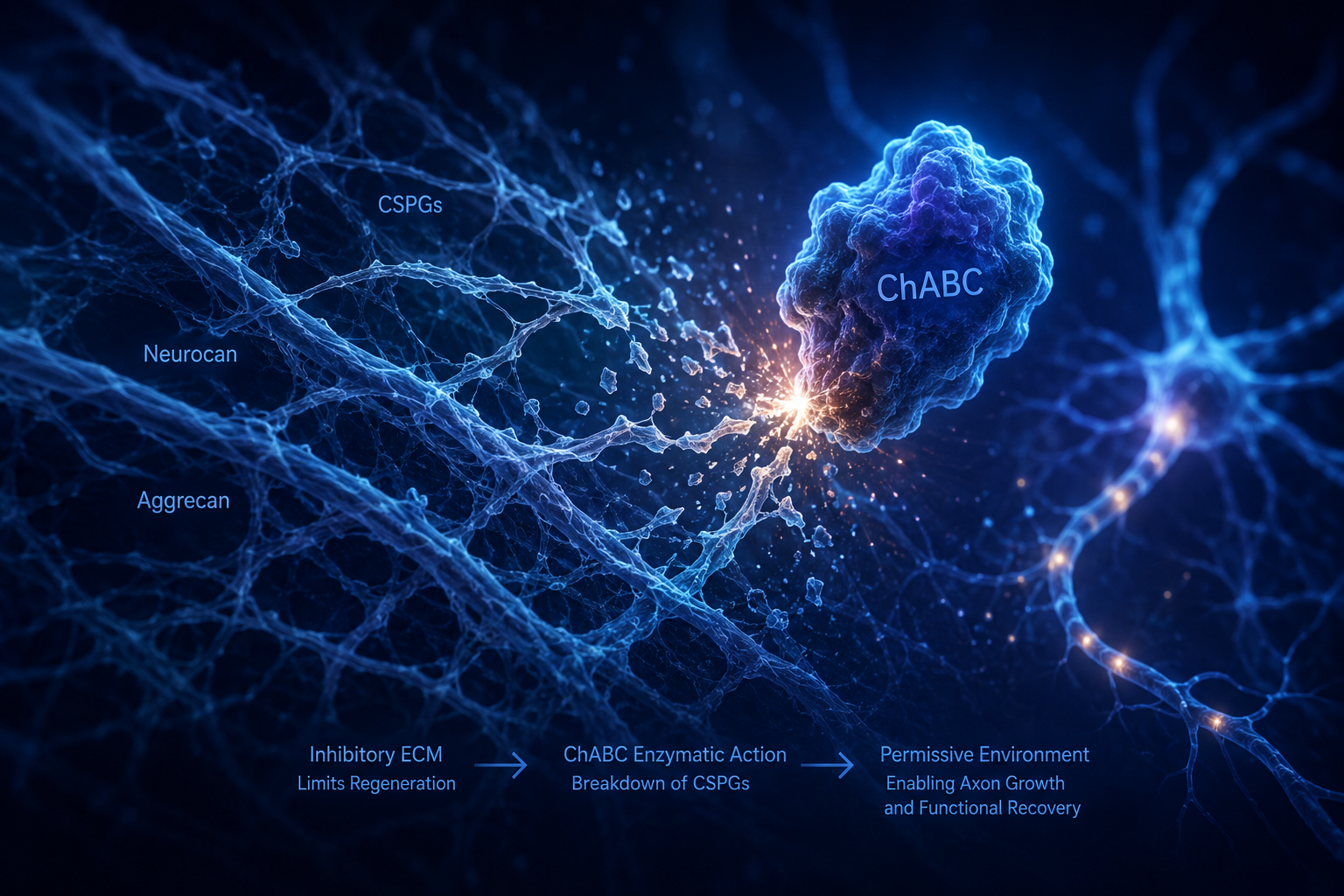
After spinal cord injury (SCI), the central nervous system responds with inflammation, cell death, and the formation of a glial scar—a dense extracellular matrix (ECM) structure that inhibits axonal regeneration and plasticity. One of the major inhibitory components of this scar is a family of molecules called chondroitin sulfate proteoglycans (CSPGs). These large ECM molecules form a biochemical barrier that prevents axonal growth and functional recovery.
Chondroitinase ABC (ChABC) is a bacterial enzyme that has been widely used in experimental models to digest CSPGs and reduce this inhibitory barrier, allowing regenerating axons and neural circuits to grow more freely.
How ChABC Works
ChABC selectively cleaves the glycosaminoglycan (GAG) side chains from CSPGs that accumulate in the injured spinal cord. By degrading these inhibitory chains:
- the physical and chemical resistance to axonal extension is reduced
- regions of CSPG accumulation are made more permissive to axon growth
- neural plasticity within spinal circuits is increased
This enzymatic action transforms a scar-rich environment into one that is more receptive to regeneration or compensatory neural remodeling.
Evidence from Experimental SCI Models
A large body of animal research shows that ChABC can promote axonal regeneration, sprouting, and functional improvements after SCI:
- In classic experiments in adult rats, intrathecal delivery of ChABC degraded CSPG GAG chains at lesion sites and allowed both ascending sensory fibers and descending corticospinal axons to grow across the injury, improving locomotor and proprioceptive function.
- In organotypic cocultures (brain–spinal cord explants), ChABC treatment increased the number of axons crossing inhibitory boundaries compared with controls, indicating that CSPG digestion directly supports axon extension.
- Studies using lesion models have shown that animals receiving ChABC demonstrated greater axon sprouting and structural remodeling than untreated animals.
A systematic analysis of many preclinical studies concluded that ChABC administration in rodents consistently improves locomotor recovery after SCI, though the effects are typically moderate and depend on injury model and timing of administration.
CSPG Digestion and Neural Plasticity
Beyond long-distance regeneration, ChABC can encourage plasticity in existing neural circuits:
- Digesting CSPGs enables both injured and uninjured axons to sprout within areas of scar degradation.
- This increased sprouting can enhance innervation of motor and sensory pathways below the injury, supporting functional compensation.
These findings indicate that ChABC doesn’t simply remove a barrier, but also unmasks latent plasticity in spinal systems that have been limited by inhibitory ECM molecules.
Modulating the Injury Environment
In addition to promoting outgrowth of axons, CSPG reduction by ChABC has been associated with:
- reduced lesion cavity size and improved tissue organization
- enhanced post-synaptic activity below the lesion
- increased expression of regeneration-associated proteins in neurons adjacent to the injury site
These effects are thought to reflect a combination of changes in the extracellular environment that make it more receptive to growth and synaptic connectivity.
Considerations and Limitations
While ChABC has shown consistent benefits in animal models, several important limitations are recognized:
- Most evidence comes from preclinical studies; human clinical trials have not yet established safety or efficacy in people with SCI.
- The enzyme is biologically unstable at body temperature and loses activity quickly, which challenges its delivery and sustained effect in vivo.
- ChABC is most effective when administered in combination with other strategies (e.g., rehabilitation or biomaterials), suggesting its best role may be as part of multimodal therapies rather than as standalone treatment.
Summary
Chondroitinase ABC (ChABC) is a bacterial enzyme that degrades inhibitory ECM molecules known as CSPGs, which accumulate after spinal cord injury and suppress axonal regeneration. A substantial body of animal research shows that ChABC treatment:
- reduces inhibitory barriers within the injury site
- promotes axon regrowth and sprouting
- supports neural plasticity and functional improvements
- alters the lesion environment in ways that may facilitate repair
These findings underscore the importance of ECM modulation as a research direction in neural regeneration and SCI recovery.
Key References
- Bradbury EJ, Moon LD, Fawcett JW, et al. Chondroitinase ABC promotes functional recovery after spinal cord injury. Nature. 2002.
- Nakamae T, Tanaka N, Nakanishi K, et al. Chondroitinase ABC promotes corticospinal axon growth in organotypic cocultures. Spinal Cord. 2009.
- Shields LBE, Zhang YP, Burke DA, et al. Benefit of chondroitinase ABC on sensory axon regeneration. Surg Neurol. 2008.
- Meta-analysis: ChABC shows moderate improvements in locomotion recovery after SCI in rodents.