
Pharmacologic and Cellular Approaches in Spinal Cord Injury: A Critical Overview

Article reviewed:
Khalid SI et al. Pharmacologic and cellular therapies in the treatment of traumatic spinal cord injuries: A systematic review. Journal of Clinical Neuroscience, 2020.
Context
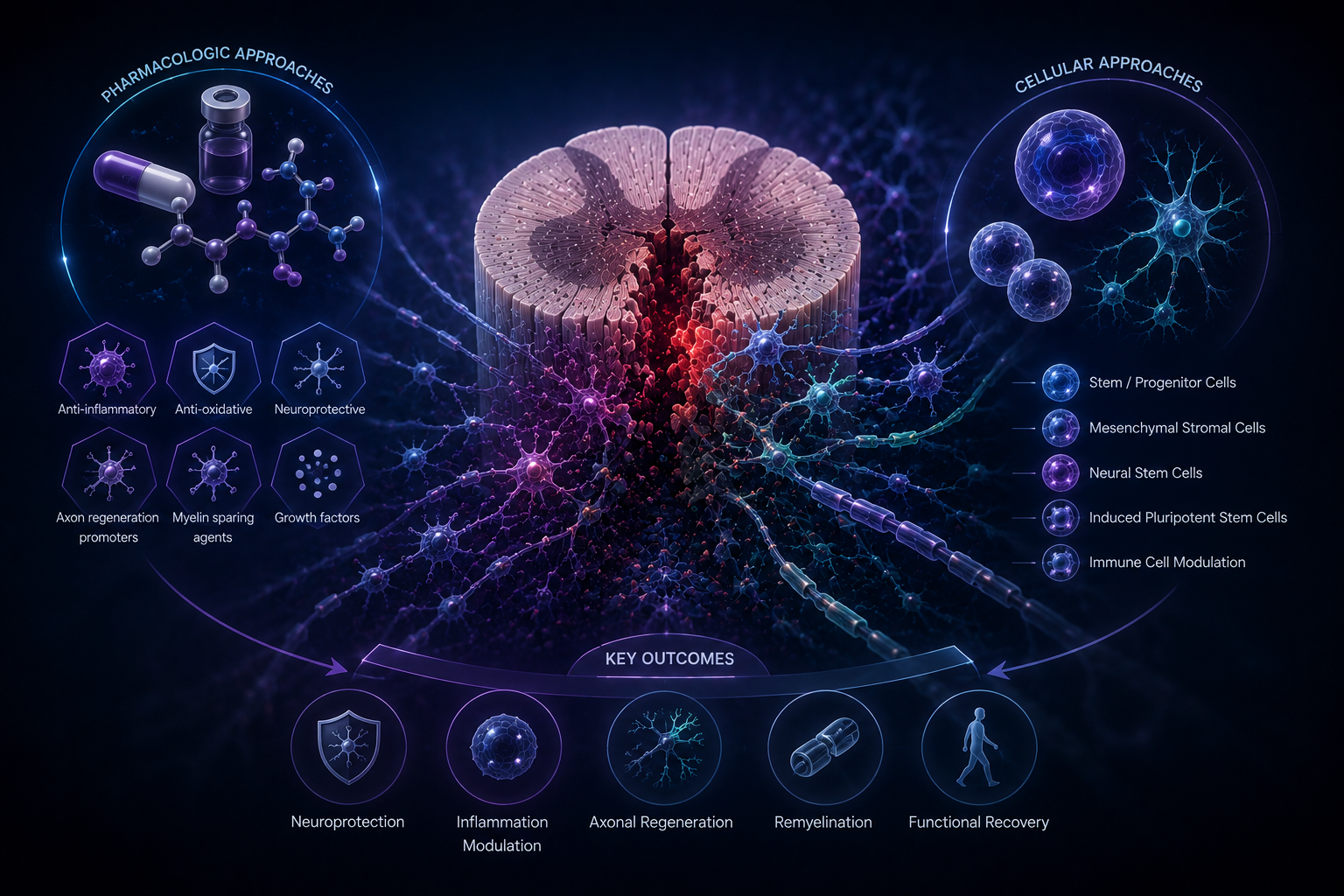
Traumatic spinal cord injury (SCI) remains one of the most complex challenges in neurological medicine. Despite decades of research, no single therapeutic approach has emerged as clearly effective in restoring function. Khalid and colleagues present a systematic review that consolidates clinical and preclinical efforts across pharmacological, molecular, and cellular strategies, offering a broad perspective on where the field currently stands.
Rather than proposing a single solution, the review emphasizes the multifactorial nature of SCI pathology and the difficulty of translating promising laboratory findings into consistent clinical benefit.
Understanding the Therapeutic Landscape
The authors organize existing approaches around several major categories, reflecting the layered biology of SCI:
- Physiological strategies aimed at minimizing secondary injury (e.g., hypothermia, cerebrospinal fluid drainage, blood pressure management)
- Pharmacological interventions targeting inflammation, excitotoxicity, or ion imbalance
- Molecular approaches focused on modifying inhibitory signaling pathways
- Cell-based therapies designed to promote regeneration or remyelination
Across these categories, a recurring theme emerges: many interventions show promise in controlled experimental models, yet demonstrate variable or limited efficacy in clinical trials.
Pharmacological Interventions: Promise and Limitations
The review provides a detailed examination of several pharmacological agents, including methylprednisolone, minocycline, riluzole, and others. While some drugs have shown neuroprotective effects under specific conditions, the overall clinical evidence remains mixed.
For example, corticosteroids such as methylprednisolone have long been debated due to inconsistent benefits and significant side effects. Other agents, including minocycline and riluzole, exhibit encouraging signals in certain patient subgroups, but lack sufficient data to support widespread adoption.
A key insight from the review is that timing, dosing, and patient stratification play critical roles in therapeutic outcomes—factors that are often difficult to standardize in clinical settings.
Molecular Targets and the Inhibitory Environment
Beyond pharmacology, the authors discuss molecular strategies aimed at overcoming the inhibitory environment of the injured spinal cord. These include approaches targeting myelin-associated inhibitors, Rho/ROCK signaling, PTEN pathways, and extracellular matrix components such as chondroitin sulfate proteoglycans (CSPGs).
Notably, many of these interventions demonstrate strong mechanistic rationale and robust preclinical results. However, clinical translation remains limited, underscoring the gap between biological feasibility and therapeutic reliability.
The review highlights how modifying a single inhibitory pathway is often insufficient, given the redundant and overlapping mechanisms that restrict regeneration after injury.
Cellular Therapies: Complexity Over Simplicity
Cell-based therapies—including mesenchymal stem cells, oligodendrocyte progenitor cells, Schwann cells, and olfactory ensheathing cells—represent another major area of investigation. While these approaches aim to support regeneration, remyelination, or immune modulation, their outcomes vary widely.
Clinical trials generally demonstrate safety and feasibility, but functional improvements are inconsistent and often modest. The authors emphasize the importance of understanding how transplanted cells interact with the host environment, rather than viewing them as standalone solutions.
This section of the review reinforces the idea that cellular therapies may be most effective as part of combinatorial or context-dependent strategies.
Key Takeaways and Open Questions
Rather than presenting definitive conclusions, the review leaves the reader with several important considerations:
- SCI pathology involves intertwined biological processes that cannot be addressed by single interventions alone.
- Many therapeutic strategies show context-dependent effects that challenge standardized clinical implementation.
- Translational gaps persist between experimental success and clinical efficacy.
- Integrated approaches and improved experimental models may be essential for progress.
Importantly, the authors refrain from overstating the impact of any individual therapy, maintaining a balanced and critical perspective throughout.
Reflection
This review serves as a valuable synthesis of the current therapeutic landscape in SCI research. Its strength lies not in proposing a breakthrough, but in clarifying why progress has been incremental and why careful, multi-layered investigation remains necessary.
For researchers and clinicians alike, the paper reinforces the importance of methodological rigor, realistic expectations, and continued exploration of both biological mechanisms and experimental design.
Reference
Khalid SI, Nunna RS, Maasarani S, et al. Pharmacologic and cellular therapies in the treatment of traumatic spinal cord injuries: A systematic review. Journal of Clinical Neuroscience. 2020.
